Saturday, December 11, 2010

Theatre Review: Dancing at Lughnasa (2010)


"Dancing for Attention"

By Jordan Overstreet
Published: December 6, 2010

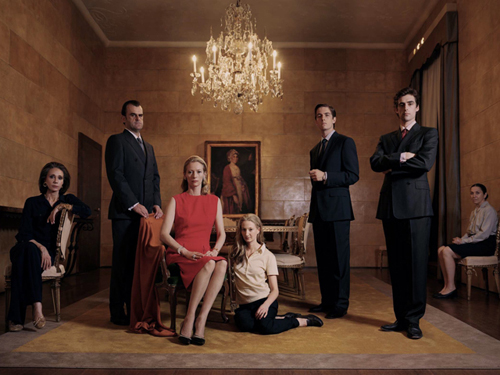
Theatre Sewanee’s recent production of “Dancing At Lughnasa” reminds you of that first Thanksgiving dinner at the adult table. Irish playwright Brian Friel, like your well-meaning mother, believes you will benefit from this time with your elders. At first you are thankful for the promotion, but once you are seated amongst a familiar collection of relics from the early 20th century with their constant overlapping chatter and never-ending punch lines that are foreign to your contemporary ear, you soon wish for a one-way ticket back the to kids’ corner.

The two and a half hour memory play is void of witticisms and bathroom humor necessary to hold the attention of a college audience. Instead Friel relies on the convention of storytelling as a means to reel us in. Enter Michael Evans (Michael Caskey), the narrator of our tale and illegitimate son of Christina Mundy (Genevieve Melcher), who recalls the summer of 1936 in Ireland and introduces us to the five women who raised him.

The Mundy family, consisting of five unmarried sisters, is headed by the eldest, Kate (Tori Nettleton), in the absence of their brother Jack; however, Kate’s rule is threatened by the homecoming of a Malaria infected Jack from Uganda. As a man of the cloth, Jack was once popular in the community, yet since his return he seems to have abandoned his Catholic leanings and, as Kate puts it, “gone native.” While Jack’s apparent defrocking stains the family reputation, this event is not the only dilemma of the summer of 1936. The summer also brings Michael’s father, Gerry Evans (Jordan Craig) and the construction of a knitwear factory, which threatens to destroy the hand knitted glove industry, the only source of income fore Agnes and Rosie Mundy (Katherine Izard and Rebekah Hildebrandt). Michael attempts to string together these unrelated memories of that fateful summer, suggesting this series of events will ultimately change the Mundy family dynamic forever.

“Dancing At Lughnasa” will make you realize how clever Beth Henley’s “Crimes of the Heart,” performed last fall, is. While both plays explore similar themes, including the familial bonds between sisters, and set the dramatic action in the kitchen, Henley maintains a stronger grasp on the differing personalities of her female characters, and, most importantly, she allows the audience to function as a character. By inviting us to take part in the action, be it sharing an inside joke with a character or witnessing a moment of desperation between two lovers, we develop a relationship with the personas we see on stage. We want to know who these people are and what they are going to do next.

Friel does not do us the same courtesy; rather he overpopulates his kitchen with five female characters, leaving the audience isolated and unable to find a seat at the dinner table. The Mundy sisters begin the play speaking their lines on top of one another and never seem to break this habit. We want to understand who these women are, but Friel does not let us get too close. While he makes sure to give Kate, who is expertly portrayed by Miss Middleton, her defining moment, he seems to have forgotten the other four sisters; thus making it difficult for these well-rehearsed actresses to translate their individual character’s motivations to the audience.

Take for example the flight of Agnes at the end of the play. While Miss Izard does her best to illustrate Agnes’ unhappiness in the Mundy home during the first act of the play, Friel only gives her three minutes of dialogue to articulate her feelings; and when it is later revealed that she leaves the family, her departure feels out of character and not believable.

The set, while beautifully decorated by Samantha Gribben, seems to further ostracize the audience from the action on stage. Taking up the majority of the stage, the Mundy kitchen commands our focus. The majority of the first act, which seems to last an eternity, is spent in the kitchen of the Mundy home. Because Friel does not include any scene changes or entrances of new characters in a timely manner, the audience loses its focus. The only break we have from the estrogen-charged atmosphere is the arrival of Gerry Evans.

From the moment Gerry gallivants across the Mundy garden, he demands our attention. With the help of fluid blocking from Pete Smith and colorful stories from Friel, Gerry charms both Christina Mundy (Genevieve Melcher) as well as the audience with his stories from the road. With the dashing Mr. Craig in the lively role, it is only natural that our attention would be pulled in his direction. However, while this scene is set outside of the Mundy home, the sisters never leave the stage and Maggie Mundy (Keller Anderson) is forced to maintain the fourth wall by watching their exchange from the envisioned windows of the home. Nonetheless, when Mr. Craig exits, we are once again lost and trapped in Friel’s scatterbrained world.

Despite its popularity in the early 1990’s and its Tony Award for Best Play, “Dancing at Lughnasa” seems to be a poor selection for such a talented group of young actors. Theatre Sewanee’s archaic reading of what some consider Friel’s masterpiece does not speak to a contemporary college audience, specifically the Southerners that dominate Sewanee’s student population. We have no knowledge of the Irish mentality; conceivably if we did, we would be better equipped to comprehend Friel’s vision.

Nonetheless, without being bribed by our English 101 professors to see David Landon’s annual Shakespeare production, students are unlikely to see a play at all. Perhaps is time for the Theatre department to tailor their future projects to a contemporary audience; these brilliant thespians deserve the opportunity to perform for a full house. Is it too much to ask for a production of a Tennessee Williams’ play?

Sunday, November 21, 2010

Film Review: You Again (2010)

"More Bad Writing, Again"

By: Jordan Overstreet
Published: November 4, 2010

In “Sunset Blvd” screenwriter Joe Gillis whores his linguistic services out to Norma Desmond because, “sometimes it’s interesting to see just how bad bad writing can be.” Like Norma’s reworking of “Salome,” Andy Flickman’s recent flick for Touchstone Pictures “promises to go the limit.”

“You Again” will make you realize how clever Mark Water’s “Mean Girls” is. Both movies (Note: they are not films) explore similar themes of high school bullying; however, while “Mean Girls,” written by funny lady Tina Fey, ushered in a new potential for the type of humor associated with high school flicks, “You Again” resorts back to every bad cliché that managed to find its way onto your 9th grade English teacher’s wall.

The script, penned by Moe Jelline, is littered with falsities like, “they say who you are in high school is who you will be in life” (and to think Vince Vaughn is getting heat from anti-gay bulling circles for saying “Ladies and Gentlemen, electric cars are gay” in the trailer for his recent film, “The Dilemma.”) What’s offensive isn’t Vaughn’s line, which is actually original; what is offensive, however, is the fact that the American movie-going population is being subjected to such poorly written movies due to Hollywood’s need to make a buck.

Directed by Flickman, who disappointed us with 2007’s “She’s the Man,” “You Again” is a sickeningly sweet Disney smoothie of “Mean Girls” and “My Best Friend’s Wedding.” The movie begins in 2002 with the pimply Marni (Kirsten Bell) as she is taunted by other students led by head cheerleader Joanna (Odette Yustman). Joanna and her minions break out into Queen’s “We Are the Champions” and their sassy expressions as they sing seem to isolate Marni as the total loser. Needless to say, I could feel Freddy Mercury do back handsprings in his grave.

Flash-forward six years (doesn’t feel long enough, right?), and Marni, now a vice president at an elite PR firm, returns home for her older brother Will’s (James Wolk) wedding, only to find that the bride is her high school nemesis. When an overly kind Joanna claims not to remember Marni, Bell channels Julia Roberts circa “My Best Friend’s Wedding” and tries to expose Joanna’s evil side by any means necessary. Seeing as all three of them attended the same small high school in California, it seems odd that Marni would be in the dark about who her brother is marrying; this is just the first of many continuity problems throughout the script.

With Jamie Lee Curtis, Sigourney Weaver, and fiscal powerhouse Betty White onboard, this cinematic voyage should be, at the very least, moderately humorous. However, Jelline, who makes her screenwriting debut in “You Again,” is merely a child and her lack of practice shows. She relies too heavily on over used pop culture references like Facebook, so when Betty White reveals that she is “on the Twitter,” and the few people in the theatre laughed, I almost choked on a Sour Patch kid. White deserves wittier dialogue and, while I do hate to say it, it may be the end of her rejuvenated career. There are only so many absurd things an old lady can say.

Kirsten Bell is forgettable in her role as Marni and lacks the spunk needed to evoke a connection from the audience. She is a weak actress who is constantly upstaged by her leading men, be it the very talented James Wolk in this film, Josh Duhamel in “When in Rome,” or Jason Bateman in “Couples Retreat.” It’s time she got the memo that she needs acting lessons. As for Sigourney Weaver, I was excited to see her return to the screen but was perplexed by her attachment to such a low quality film. Perhaps the alumnus of the Yale Drama School needs to eat.

With the rise in online subscriptions to iTunes, Netflix, and Video On-Demand, the way people watch movies is changing, and the amount of people actually seeing a movie in a theatre is diminishing. At the end of the day, the movie-making industry is a business and in order to function that way, theses studios have to make money from the films they release. And nothing spells box-office return like an all-star cast.

“You Again,” like so many Disney movies, is cleverly packaged by those sly Mickey Mouse bastards with an array of celebrities to ensure a hefty fiscal return. They target the American family: Grandma chuckles with Betty White; little Suzie shares an inside joke with Kristen Bell; Mom reconnects with her past heroines, Jamie Lee Curtis and Sigourney Weaver; and Dad gets to foot the bill.

While I commend Disney for getting people to the theatre, I’m appalled by the lack of entertainment they expect us to swallow. The jokes aren’t funny and “You Again” is so poorly written that not even Weaver can deliver these lines with dignity; I doubt any actress can. Earth to Disney, your audience isn’t stupid, so stop writing like we are.

“You Again.” Directed by Andy Flickman; written for the screen by Moe Jelline; produced by Touchstone Pictures. Starring Kirsten Bell, Jamie Lee Curtis, Sigourney Weaver, Odette Yustman, Victor Garber, James Wolk, and Betty White. Rated PG for some strong language. Run time: 1 hour and 45 minutes.

Saturday, November 6, 2010

Film Review: Never Let Me Go (2010)


"Brother Could You Spare an Organ?"

By: Jordan Overstreet
Published: November 8, 2010

Human suffering is at its bleakest at the hands of novelist Kazuo Ishiguro, who is known for his tales of heartbreak and unrequited love affairs. His depressing depictions of human relationships have seen the silver screen twice before in 1993’s “Remains of the Day” and 1995’s “The White Countess,” and his highly regarded dystopian novel Never Let Me Go gets the Hollywood treatment by Mark Romanek in a film version of the same name. Amidst the dreary English countryside, this coming of age story follows the lives of three British students, groomed to serve as “donors” to the population of this Orwellian society. While many science fiction films focus primarily on the special effects and gore of the genre, “Never Let Me Go” is, at its core, a love story, and a tragic one at that matter.

The film begins in the 1990’s in a sterile operating room as Cathy H. (Carey Mulligan, “An Education”) watches her friend and girlhood crush, Tommy (Andrew Garfield) being prepped for an operation; as the doctors spread iodine across his youthful stomach, Cathy recalls her first encounter with Tommy during their schooling at the Hailsham school in the 1960’s. Cathy, Tommy, along with Ruth (Keira Knightly), appear to be normal boarding school students until your eye begins to pick up on their academic curriculum. Dispersed between their arithmetic lesson and geography class, we see the students take part in obscure exercises (role playing real world activities such as visiting a café, taking medicine tablets before bedtime, purchasing damaged toys, etc). While these activities raise suspicion, Romanek makes sure that we do not get ahead of Cathy and the other children by presenting information from a child’s perspective. As the threesome ages, so does our perspective, and we begin to understand the injustice that is forced upon those created to be “donors.” Yet, the three do not age physically; rather their age is illustrated in the change that occurs in their dynamic; thus when Ruth catches Tommy’s eye and the two move from friends to lovers, fate seems to roll in and create a series of “unseen tides.”

To go into any more detail in regards to the plot would be a disservice to a future spectator and would seriously undermine Romanek’s vision, which has so carefully translated Ishiguro’s descriptive passage into live action. I must stress that “Never Let Me Go” is not a fast-paced drama, layered with heavy dialogue. Speaking is only used when necessary as means to highlight the unspoken things--a wayward glance, a body of a “donor” left to rot after her final donation, a tree covered in plastic bags. It is in these silent moments where Romanek is at his most brilliant, allowing mise en scen to dominate.

The final chapter of the film returns to the early 1990’s and takes the story in an odd direction, in hopes of explaining the purpose of Hailsham. While the final revelation, or “twist,” is predictable, Mulligan and Garfield project raw emotions and their responses to the unveiling of one of the many lies told to them at Hailsham is genuine. They breathe an air of authenticity to the trite realization and save the scene from melodrama. While Mulligan and Garfield will never be Liz and Dick, they compliment each other on screen. Taking an uncharacteristically supporting role, Knightly makes, perhaps, her best performance onscreen since “Pirates of the Caribbean.” She has abandoned her wilting ingénue type and adopted a real, manipulative femme fatale persona. Knightly was a nice surprise to find roaming the halls of Hailsham.

If the dystopian novel is a cultivation of our fears about a particular aspect of society, then George Orwell’s 1984 is an allusion to the growing fear of the spread of communism in the 1940’s, for he forces us to explore what our world would be like under the Iron Curtain; similarly, Ira Levin’s The Stepford Wives capitalized on the growing Feminist movement of the 1970’s, leading women to ponder what would happen if the male sex did not go along with the new rights bestowed upon them. If this is the case, then “Never Let Me Go,” must be addressing the rising shortage for organ donors in the United States. While not as socially jarring as 1984 and The Stepford Wives, “Never Let Me Go” is an interesting exploration into our future and deserves to be more than just another film to add to the resumes of Mulligan, Garfield, and Knightly.

"Never Let Me Go." Directed by Mark Romanek; written for the screen by Alex Garland; produced by Fox Searchlight Pictures. Starring Carey Mulligan, Keira Knightly, Andrew Garfield, and Charlotte Rampling. Rated R for some sexuality and nudity; run time 1 hour and 43 minutes.

Wednesday, October 27, 2010

Film Review: Of Gods and Men (2010)


"A Bedtime Story for Grown-ups"

By: Jordan Overstreet
Published: October 27, 2010

If a good night’s sleep is on your Christmas list, skip the pharmacy and treat yourself to a nap out on the town this January by seeing "Of Gods and Men." Based on true events, Xavier Beauvois’ "Of Gods and Men" seeks to explain the mysterious 1996 execution of seven French Catholic monks by a radical Muslim group in remote Algeria. You would imagine with a logline like that, focusing on the story would be a simple task; however, this 2010 Festival de Cannes Grand Prix winner is visual Ambien.

The French film follows the lives of nine monks, lead by veteran actor Lambert Wilson, who run a monastery in a small, rural area of Algeria. There is nothing sexy about watching what I consider to be the AARP sect of the French Catholics in Algeria. They sing, chant, and pray far more than they actually articulate speech. Granted, monks lead relatively quiet lives, but couldn’t Beauvois have lied just a little and made them more interesting or at least, dare I say it, sexy?

Being an American citizen, I was unfamiliar with the events surrounding the disappearance of these monks. Although any introductory level history class will teach you that French-Algerian relations have been strained (to say the least) since the Algerian fight for their independence in the 1950’s, Beauvois provides the spectator with little background information surrounding the conflict. I am not asking that he hand us a syllabus; I would like for him to consider for the importance of the historical context. Time and time again, we are asked to feel threatened by these radical Muslim sects through the use of violence; however, without any background information or sub-plot to help the audience understand the characters on screen, the threat of death does not feel believable.

As the film wore on, I kept being reminded of Michael Powell’s drama “Black Narcissus,” which follows the trials of a group British nuns, headed by Deborah Kerr, in imperial India. Underscored by the plight of British imperialism in the East, Powell’s film explores how these nuns cannot cohabitate with the wild, untamed environment that surrounds them, proving that the jungles of India are no place for God. However, Powell’s film possesses a sub-plot, a commodity desperately needed in “Of Gods and Men” to allow the spectator to better understand the characters on screen. For instance, when Kerr leaves the Indian jungle at the close of the film, I understand who the woman I see before me is, and when she cries, I can feel empathy for her--she has failed God.

In contrast, Beauvois does not give us a sub-plot or flesh out his characters, but relies on shots of terrorists with guns juxtaposed by the reaction shots of crying monks to bolster our fear of violence. He clearly wants us to see these men as martyrs, but their characters, due to a lack of dialogue, are never really developed, so how are we, as an audience, expected to feel for them? As the cowardly tears pour down the monks’ faces, they lose any hope of appearing heroic and (forgive me for sounding like Lady Macbeth) come off as weak. You would think nine grown men had the balls to fight off a few intruders.

Beauvois attempts to place a French perspective on the end of the Francophone empire and Algeria’s involvement in that plight. With the lack of heroism on the part of the monks, they become cowardly sacrifices that limp along in this lifeless drama, and Beauvois fails at delivering this perspective. “Of Gods and Men” is successful in providing further evidence that the Franco-Algerian conflict is far from dormant. So whatever France and Algeria have going on, I think its time they engage in a dialogue, preferably in a shrink’s office and not on the silver screen.

"Of Gods and Men." Directed by Xavier Beauvois; written for the screen by Xavier Beauvois and Etienne Comar; produced by France 3 Cinema; starring Lambert Wilson, Michael Lonsdale, Olivier Rabourdin, Philippe Laudenbach, Jacques Herlin, Loïc Pichon, Xavier Maly, and Jean-Marie Frin. Rated R for a scene of graphic violence. Run time 2 hours and 2 minuets.

Film Review: Love Ranch (2010)


"Not Another Cougar Movie"

By: Jordan Overstreet
Published: October 14, 2010

Helen Mirren, brothel madam.

Not the two words you would usually associate with the Academy Award-winning Dame of the British realm; however, in Taylor Hackford's recent film "Love Ranch," Mirren makes the leap from Queen Elizabeth II to Nevada brothel owner Grace Bontempo.

With the collapse of the film's distribution company in early 2009, "Love Ranch" was placed on the shelf for over a year; and finally saw its release this past May in the market at the 62nd Festival de Cannes. Based on the real life events surrounding the 1976 murder of Argentine heavy weight Oscar Bonavena at Joe and Sally Conforte's Mustang Ranch, the film follows Grace and Charlie Bontempo (Mirren and Joe Pesci) as they run the first legal brothel, the Love Ranch, in 1976 Nevada.

While perhaps an unlikely vehicle for Hackford, whose last directorial venture was 2004's "Ray," his marriage to Mirren must have influenced him to take on the project. Nonetheless, it is Hackford's direction of the film that makes what sounds like another installment of the sleazy Home Box Office (HBO) series, "Cathouse" (which captures the daily ups and downs of the Bunny Ranch in Nevada), actually plausible and dramatically entertaining. "Love Ranch" is, at its core, a story about the dissolution of a marriage.

The film begins with Grace, sporting a sleek auburn bob, confessing to the audience, "Selling love will make you rich...that's what my mother taught me...just don't put your heart into it." As the title credits saunter across the silver screen and the sounds of Kool and the Gang become audible, we are transported to the brothel's 1976 New Year's celebration, during which Charlie, on a whim, announces his plan to make the brothel a high-class destination by investing in a new attraction for his clientele-a boxer. As Grace, recently diagnosed with terminal cancer, glares from the sidelines, Hackford gives the audience a sense of the union between the Bontempos. While rough around the edges (Charlie is a known bed partner to many of the ladies of the Ranch), their marriage is based on a strong business partnership, with Charlie as the face of the brothel and Grace working as the engineer behind the operation.

Mirren and Pesci are well matched to portray these middle-aged felons. Mirren is able to shed her royal persona and reinvent her onscreen image through the role of Grace Bontempo. Upon first glance, Mirren is unrecognizable. With her red hair coiffed in a beehive up-do and her eyelashes coated in mascara, Mirren could be Tammy Faye Messner's doppelganger.

No victim from the 1970's makeover, Pesci conjures up images of an older Elvis as he sports a purple leisure suit with matching cowboy hat and boots. Pesci, the great character actor of crime moguls, is up to his usual tricks in his role as Charlie. It as if he has aged to perfection and Mark Jacobsen's dialogue allows Pesci to open up like a good reserve wine. Similarly, Jacobsen has crafted such witty one-liners for the two to sling at each other that even in the most heated of arguments, Mirren and Pesci are still fun to watch onscreen.

However, the partnership between the Bontempos begins to crumble with the arrival of Charlie's newest attraction-the boxer, Armando Bruza (Sergio Peris-Mencheta). Focused on his effort to legitimize the business of prostitution, Charlie leaves Grace in charge of managing Bruza's boxing career. While Grace complains, "I've got twenty five psychotic whores to manage," she ultimately takes on training the Argentine Neanderthal. Then the writers from "Days of Our Lives" must have hijacked Jacobsen's script and proceeded to write in a love story between the sixty-five year old Grace and the thirty-three year old Bruza.

In spite of the recent circulation of photographs of a very toned Mirren clad only in a bikini, there is nothing sexy about Mirren bedding Peris-Mencheta. As they tussle in scarlet satin sheets, I can feel my gag reflex kick into high gear. Their liaison is totally unbelievable, and when Grace plans to actually run off with Bruza, Mirren just looks pathetic and, while I hate to say it, old. I will forever be indebted to Charlie's bodyguard, who finally puts the audience out of its misery, by shooting Bruza and restoring reality. While Mirren sobs over her lover's lifeless body, there is not a wet eye in the theatre. Regardless of Mirren's appeal, she cannot make Grace's relationship with Bruza work; perhaps no actress can.

"Love Ranch," despite its flaws, is a campy piece of entertainment. That is, of course, if you can allow yourself to get wrapped up in the cinematic experience and actually believe that everything you are seeing on screen, even the bizarre union of Mirren and Pers-Mencheta , is plausible. For the more enlightened movie-goers, this may be a difficult feat; however, for the housewives of suburbia (and my mother), I suspect it will be a hit. While "Love Ranch" will be released on DVD in November, I hope the problems Hackford and others experienced in releasing the film is a sign from the movie God that the era of the cougar is coming to an end.

Love Ranch. Directed by Taylor Hackford; written for the screen by Mark Jacobsen; released by E1 Entertainment International; starring Helen Mirren, Joe Pesci, Gina Gershon, Taryn Manning, and introducing Sergio Peris-Mencheta. Rated R; run time: 117 minutes.

Film Review: I Am Love (2010)


"Tilda, the Great"

By Jordan Overstreet
Published: September 30, 2010

While many critics have coined Meryl Streep as ‘chameleon-esque' in her acting abilities, it appears another reptile has entered the cinematic aquarium and may possess the power to uproot ‘the world's greatest living actress' from her throne. This force is art house pioneer, Tilda Swinton.

Since her move to mainstream films in 2000, Swinton has re-invented the feminine image on screen. Her Academy-award winning performance as the ruthless Karen Crowder in 2007's "Michael Clayton" not only exposed the softer side of the stock businesswoman prototype, but also gave audiences a taste of her talent; she promptly delivered the main course in the 2008 French indie thriller, "Julia," in which Swinton portrays an alcoholic party girl on the brink of self-destruction. Her Oscar has proved to be invaluable and has allowed Swinton the rare opportunity to bring art house cinema to the megaplex in Luca Guadagnino's "I Am Love," which comes to DVD on October 12th.

Shedding her natural complexion, boyish figure, Swinton adopts the trappings of an haute bourgeois matriarch caught in a ‘May-December romance' with her son's business partner in the recent Italian drama. While set in Milan at the turn of the 21st century, the presentation of the title credits and the traditional lettering of "I Am Love" invite the audience to return to an older era of women's films starring the likes of Ingrid Bergman or Deborah Kerr, which capitalized the allure of an extra-marital affair as a vehicle for the leading lady to embark on voyage of self-discovery despite ultimately returning to the arms of her husband. However, Guadagnino's protagonist, Emma Reechi (Swinton), evades this fate, placing a modern spin on the woman's melodramatic formula.

When we first meet Emma, her servants surround her in her kitchen, evoking an image of upper class Italian domesticity. While she speaks perfect Italian, hosts the family dinner soirees, and sports the uniform of the bourgeois women (a Chanel shift dress with a coordinating quilted tote in hand), her Russian descent - red hair and harsh bone structure - keep her from truly becoming a member of the Reechi dynasty that she has married into. Emma's comfort zone is the kitchen, for her only outlet for expressing her Russian heritage is through the art of cooking (she is known for her traditional Russian fish soup which later becomes the indicator of her deceit).

Eventually Emma's son, Edo (Flavio Parenti) develops a strong friendship with a chef, Antonio (Edo Gabberiellini), and the two decide to open a restaurant. When Emma encounters Antonio for the first time, there is a flirtation; however, once Emma tastes Antonio's cuisine, an intense attraction exists between the two. This attraction is further bolstered when a chance meeting leads Antonio to invite Emma to his home, where once inside Emma strips off her clothing, further distancing herself from the Reechi clan.

After working for eleven years with Guadagnino to create, and later finance the drama, Swinton finally had her day in the megaplex. Despite her British heritage, Swinton is no stranger to foreign cinema and is very much at home in this Italian drama. The language rolls off her tongue with ease. Her "Emma" conjures the likes of a Virginia Woolf heroine trapped in her daily domestic routine; similarly, Swinton's performance taps into the Wollstonecraftian school of thought regarding the rights of women.

Interestingly, it is the sexual awakening of Emma's daughter, Betta (Alba Rohrwacher) that truly leads Emma into liberation. Betta returns form art school sporting a pixie haircut and engaging in a new sexual preference; moreover, Rohrwacher outshines her supporting consorts as she confides in Emma of her love for her female professor. Betta's transgression from the social norm inspires Emma to embrace her erotic nature and dive into bed with Antonio. Betta's transformation foreshadows Emma's departure from her long strawberry locks, and this change in Swinton's appearance signifies her not only her sexual awakening, but also her return to her true identity--one that is independent of the Reechi family.

The script, written by Guadagnino, is simple--perhaps too simple--and much of the subtext is communicated by the facial expressions of the actors. Dining together is a ceremony for the Reechis, during which only the male members of the family happen to have any dialogue, and Guadagnino overpopulates the film with this tradition. Ironically, the family dining scenes are verbally anorexic. They rely heavily on continuous close-ups and reaction shots of the attendants as means to further the plot. The casual eye roll becomes a deadly weapon and can inspire the most exaggerated responses from those who witness it being used.

Guadagnino continues to pour salt in our wounds by underscoring this ceremony with the boisterous chords of John Addams' classical score. He seems to be trying to add an operatic component to the image on screen. Instead, Guadagnino blasts the audience with so many cinematic elements that without the clever hand of Swinton to guide us through, we become overwrought and lost in the melody of the score.

Nevertheless, "I Am Love" successfully breaks the mold of the traditional woman's picture by illustrating a philandering wife who actually leaves her husband by the time the final credits roll. Our leading ladies of the era are no longer constricted by flawed relationships, but have the opportunity to play in traffic and transgress their promises of fidelity. Like Bette Davis empowered the wartime widows of the 1940's, I predict that Tilda Swinton will, in due time, have the same ability to reach out to her audience and inspire a new generation of female movie-goers.

"I Am Love." Directed by Luca Guadagnino; written for the screen by Luca Guadagnino and Barbara Alberti; released by Sony Pictures Classic. Starring: Tilda Swinton, Flavio Parenti, Edoardo Gabberiellini, Alba Rohrwacher, Pippo Delbono, and Marisa Berenson. Running time: 2 hours. Rated R for sexuality and nudity.

Film Review: An Education (2009)


"A Sophisticated Seduction"

By Jordan Overstreet
Published : September 16, 2010

One of the fossils left behind from the grandeur of the Golden age in Hollywood is the educator- pupil relationship. It has been reproduced, reinvented, and rejuvenated for decades. The 1960's brought us Clark Gable who wanted to be Doris Day's "Teacher's Pet," while the 1970's ushered in a new era of sexual promiscuity and the student-teacher relationship found a new precedent with Mrs. Robinson's iconic seduction of Dustin Hoffman in "The Graduate." Fast-forward to the new millennium, and the student-teacher formula has been repackaged to fit Julia Roberts in "Mona Lisa Smile." The relationship between educator and pupil, which began as merely a complication in Doris and Gable's meet-cute, has journeyed to the bedroom, and with this knowledge of sexuality, has returned to the screen through Lone Scherfig's 2009 film, An Education.

Capitalizing on America's fixation with the 1960's drama "Mad Men," Scherfig sets his ‘coming of age' drama in 1961 London, a time when the city was untouched by the forthcoming Beatle-mania. As the opening credits begin to roll over images of young schoolgirls balancing books over their heads, baking cupcakes, and practicing their ballroom dance skills, Scherfig transports us to an era of innocence. We first meet Jenny (Carey Mulligan in an Academy-Award nominated role) in the classroom where her intelligence sets her apart from the other students. As an only child, Jenny is the sole mutual interest between her parents (Alfred Molina and Cara Seymour) and her goal to attend Oxford University has become the epicenter of their lives. When Jenny playfully suggests indulging in herself for the afternoon, her father laments, "What would Oxford think?" Jenny's only escape from her sheltered life is her Juliette Greco vinyl record and her dreams of one day reaching the height of sophistication.

Enter David Goldman (Peter Sarsgaard) a much older, mature vagabond in a scarlet Bristol roadster. David is a graduate of the "University of life"; he lives the sophisticated lifestyle that Jenny wants so much to experience. When David invites her to attend a concert in the West End along with his two friends Danny and Helen (Dominic Cooper and Rosamund Pike), Jenny willingly agrees; thus catapulting herself into the unknown sophisticated world of 1960's London where nothing is as it appears on the surface. Sarsgaard's charm and delicious dimples mask his bad boy persona, so even when he lies to Jenny, the audience is hypnotized by his spell. Soon Jenny comes to embody the lyric, "You've Got Me Wrapped Around Your Little Finger" as she is inducted into a new family nucleus--David, Danny, and Helen--abandoning her goal of attending Oxford.

A native of the British Isles, Mulligan is a newcomer to the American screen. Despite being a woman of twenty-four, Mulligan's reprise of her teenage years feels fresh. As Jenny blossoms out of her humble school-girl upbringing and into a chic Audrey Hepburn-esque young woman, Mulligan's performance proves that naivety and a loss of innocence are still two very powerful elements to be explored on screen; and even if she may be sleeping with and older man, she embarks on the taboo relationship with class.

While some actors would leave the character as a heartbreaker, Sarsgaard layers this wayward adulterer with a level of sadness that allows David to be multidimensional and make it that much worse when we learn that he has been conning Jenny and her family all along. Pike plays a terrific foil for Jenny in her presentation of the wise fool Helen, who is knowledgeable about sex but when it comes to literature is a complete dunce. When Jenny reveals she has gotten a "B" in her Latin class, Helen consoles her saying, "someone told me that in about 50 years, no one will speak Latin, probably. Not even Latin people." Helen's idiotic statements are just a few of many witty lines crafted by screenwriter, Nick Hornby ("Fever Pitch," "About A Boy").

Hornby adapted his screenplay from Lynn Barber's autobiographical short story, "An Education," in which she recounts her torrid affair with an older man during her final years of high school education. Hornby is far too faithful to his original source; thus, when he attempts to take liberties with Barber's tale, such as the row between Jenny and her head mistress, Ms. Walters (Emma Thompsen), he confuses the spectator into reading the film as a feminist critique of female education in the 1960's.

During the heated exchange, Ms. Walters claims, "there is nothing worth doing without a degree," and suggests that Jenny has few options--she can either work in education or the civil service. Jenny explains that she can "work hard and be bored" or live the lavish lifestyle she has created with David. Like any sixteen year-old, Jenny chooses the latter, exposing the lack of career options for women. This claim would support the notion that Jenny's education comes not from the lips of David but from the help of her mousey English teacher, Miss Stubbs, who steps in at the end of the film to help Jenny rewrite her setback. In contrast, Barber's cites her David as the teacher who exposed her to the harsh reality of life and truly educated her about the way the world worked. Barber saw these experiences as her education. Jenny seems to fall into a similar category.

So what exactly is "An Education" trying to say? Any enlightened movie-goer will recognize that it is not just the facts we learn in the classroom, but the application of these lessons and the street smarts we pick up along the way that truly shape us into the people we are today. The cinematic experience allows filmmakers the rare opportunity to challenge the audience's perceptions about life and society at large, yet "An Education" does not ponder any life altering questions. It merely warns us not to get wrapped around the finger of a well-meaning stranger, a pitiful end to a film that began so potent with possibilities.

An Education. Directed by Lone Scherfig; written for the screen by Nick Hornby; based on the memoirs of Lynn Barber; released by Sony Pictures Classic. Starring: Carey Mulligan, Peter Sarsgaard, Dominic Cooper, Rosamund Pike, Alfred Molina, Cara Seymour, Olivia Williams, and Emma Thompson. Running time: 1 hour and 40 minutes.